I feel like my crafting so far this year has been rather scattered, but despite this I am already making progress on many of my “non-resolutions” for the year. I am recognizing more and more these days as I work on bits of projects throughout the week that there is, in fact, a bit of cohesion to the crafts I explore. I have always half-jokingly made fun of myself every time I fall down another rabbit hole, thinking my gosh, do I really need another hobby? How many different crafts does one person need to learn? But just over the past few weeks I have started to recognize that while I may pick up a new craft here and there, or put one down for a few years, it all boils down to textile work in one fashion or another. This really shouldn’t have been an epiphany for me. After all, I chose the name “Spring Creek Textiles” to encompass all of my crafts, but I think it is the potential for crossover that has finally made me consider things differently. I can weave fabric to sew a shirt. I can embroider a square that I will turn into a pocket. Spin yarn to knit a scarf. I am starting to see bridges forming to connect independent islands. It also helps me feel less guilty about those crafts that get left behind for extended periods of time. It wasn’t time wasted, it was a new skill I learned that I can apply in the future when the situation calls for it. Thread, yarn, fabric… that really is my hobby, and all of these crafts I pick up along the way contribute to a better understanding of how textiles are made and used. Either that or I am just saying this to make myself feel better about falling down a new rabbit hole called blackwork embroidery thanks to my friend Tina who had shared photos of the beginning of some of her work on Facebook recently. I don’t have photos to share at the moment, but based on my miniscule understanding it is a really fascinating stitching technique that incorporates a number of different stitch patterns to create larger designs and mimic shading in a pattern while traditionally using only one color (black, or sometimes red). Naturally I ordered two reference books right away and will share more as I begin to dive deeper. Before I fall too far, I did feel that I should probably wrap up a few existing needlework projects before starting something brand new.
While I was digging around in the back of my closet to make sure I had found all of the presents I had stashed away for Kyle’s birthday (his birthday was the day before Hank passed. Happy birthday honey, I am sorry it was such a stressful week), I found a bag containing what is officially my oldest crafting project.
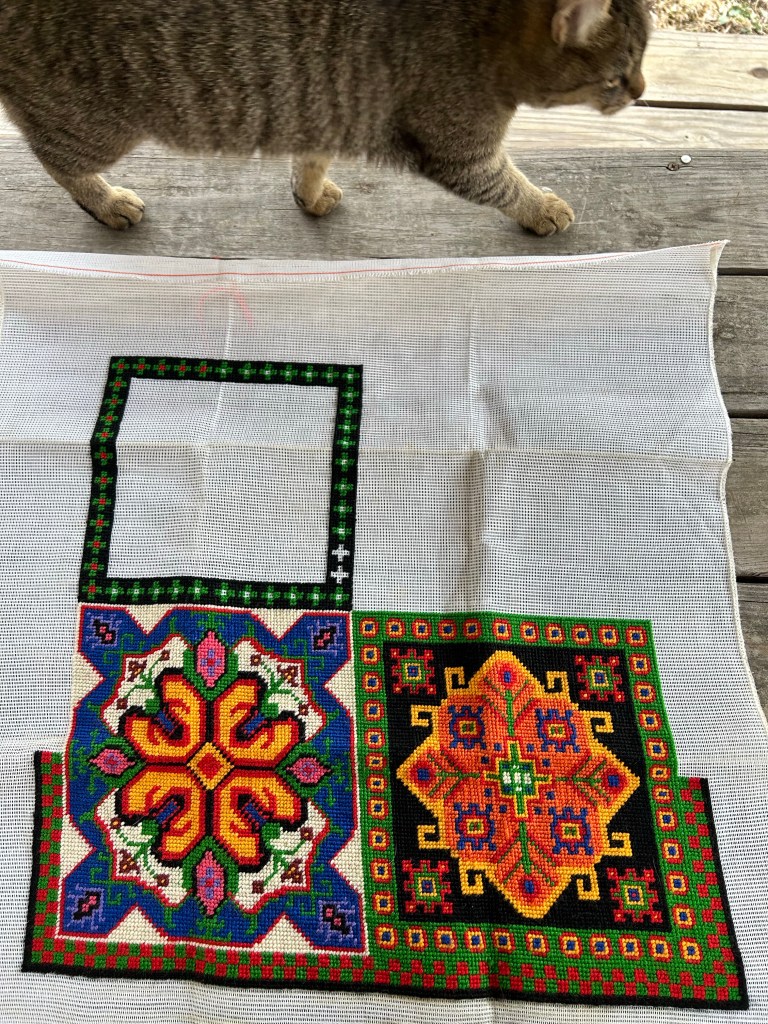
This was a kit for a pillow cover that I haven’t worked on since 2004. My mom pulled it out of her own closet and gave it to me when I was in high school. The kit itself is dated 1971. I am actually really enjoying working on this again and the colors/pattern really are very 1971. I can’t wait to watch the last two squares develop. The design is simply called “Persian Pillow”, but it has a “four seasons” vibe to me. You’ll have to let me know what you think as I continue along. To me, the two completed squares remind me of Spring and Summer, and I am working on Autumn in the top left corner now.
I also returned to my drop spindles this year after recently coming across a post in a fiber spinning group on Facebook asking members to share their favorite drop spindle. I knew immediately which of my spindles is my favorite and I pulled up this photo on my phone of a Kundert top-whorl:
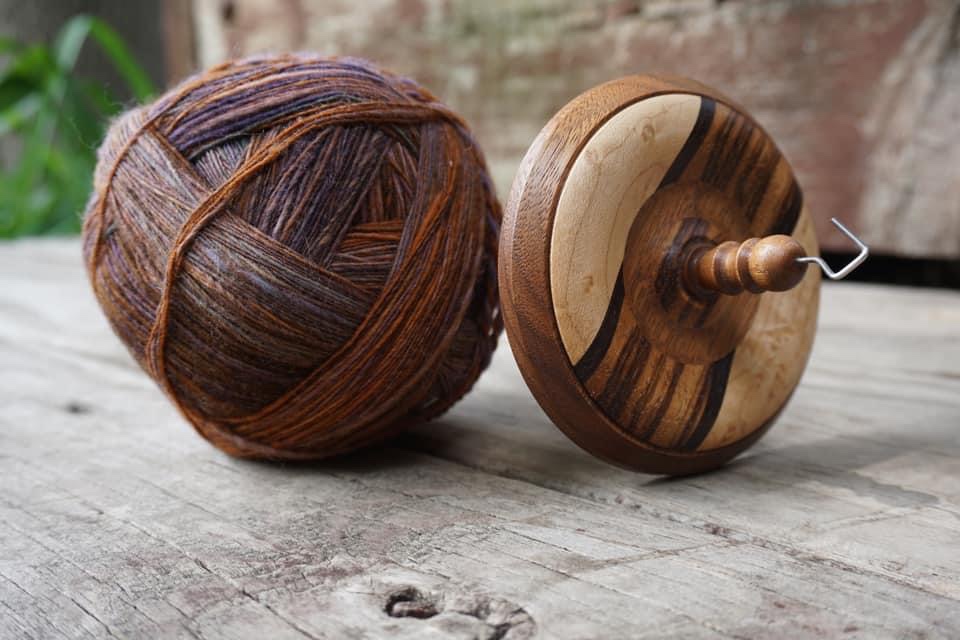
What was shocking is that I had to scroll all the way back to 2018 to find a photo of this spindle. It spins so beautifully, is well-balanced (doesn’t wobble) and is really artistically handcrafted. I was curious to find out what else Stephen Kundert had available because all of his work is stunning, and I was saddened to discover that he had passed away in 2020. I thought it was a shame that this spindle has been collecting dust for five years rather than being used, and so to honor Mr. Kundert and his art, I thought it was only right to immediately start a new spinning project with some gorgeous fiber.
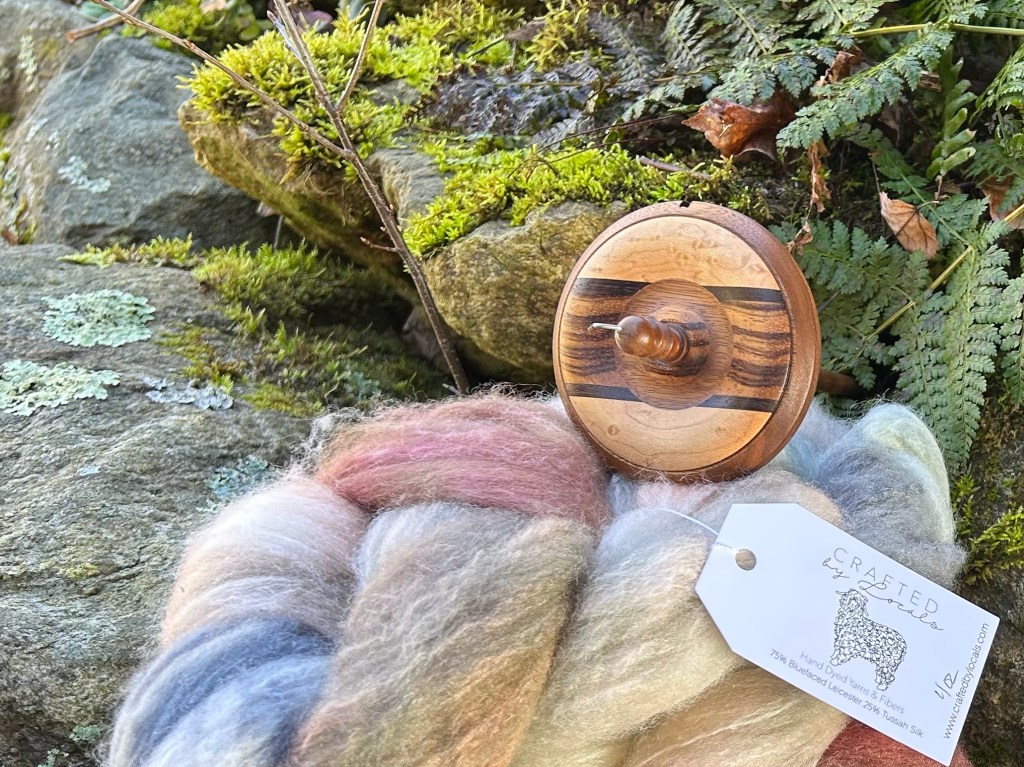
I picked up this 4oz braid of 75% BFL (Bluefaced Leicester wool) 25% tussah silk from Crafted by Locals, which is a new website to me but I am absolutely blown away by the quality of this fiber. Often with hand-dyed fiber like this, it can get pretty compacted, sometimes even matted/felted in the dyeing process, but this is so springy, light, airy, not compacted at all. I was so impressed when I opened my package that I immediately emailed the store to tell them how thrilled I was. I highly recommend checking out their website if you are in the market for spinning fiber.
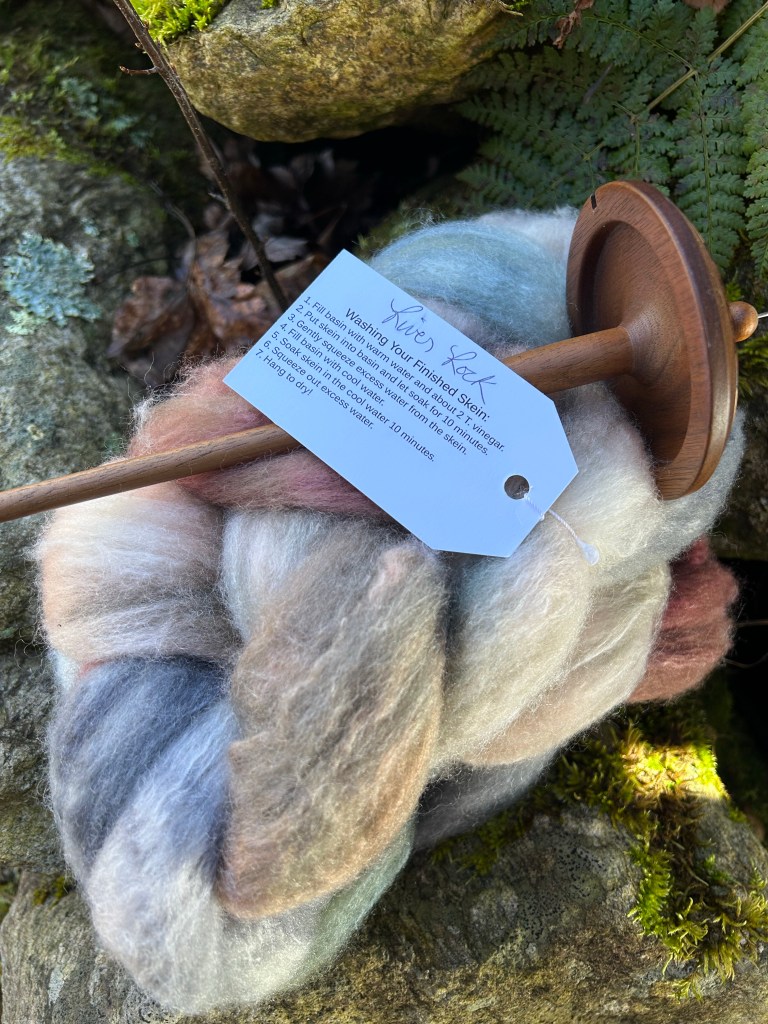
This colorway is called “River Rock”. Could it be any more perfect for me? I split this length of fiber down the middle to make two 2oz strips. I will spin two ounces on the spindle, wind it off, spin the other two ounces, and then ply those two strands together to make a 2-ply yarn. I have about 1.5 ounces spun so far and have loved every minute of it.

After learning that Stephen Kundert had passed away, I started searching online to see if any of his spindles were available for sale and I am telling you, I searched high and low and could not find a single spindle for sale. Not on Ebay, not on Etsy, not on Facebook marketplace, not on spinning guild websites… So to those of you who own one – keep it, cherish it, appreciate it, use it. In fact, I couldn’t find any drop spindle makers with products comparable to these Kundert spindles in their beauty and precision. If there are any enterprising woodworkers out there, this seems to be a gap in the market right now. As I fell deeper and deeper into the online rabbit hole of drop spindle woodcrafters, I did find one man in Canada who produces some really unique and beautiful drop spindles. His Etsy shop is called Viscountwoodturning and of course I had to order a few drop spindles from him.
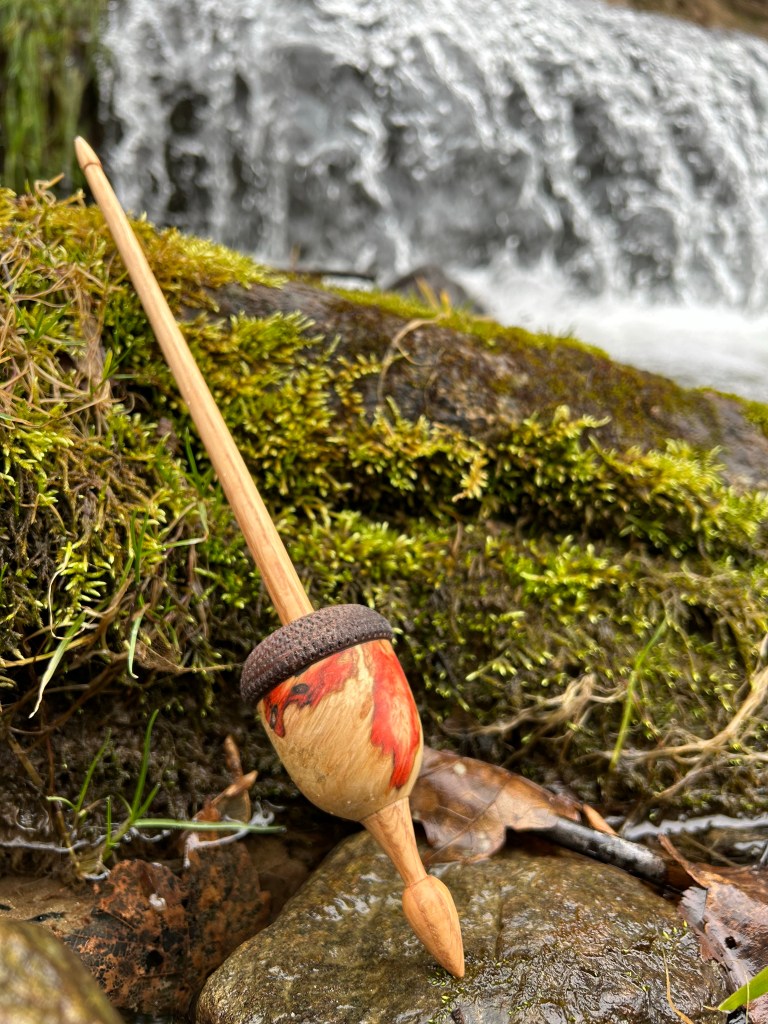
This is one of two spindles I ordered*, both of which are bottom-whorl and can be used either as a drop spindle or supported. This unique acorn shape is made with an oak shaft, box elder burl body, and walnut cap. I love to collect little rocks or acorns while hiking, so I thought this was fitting for myself. I used to have a sweatshirt with a special little pocket in the front that had a snap closure and I called it my acorn pocket because I always had an acorn or pebble in there that I was keeping safe. Yes, as an adult. Kyle still gets gifts of little pebbles every time I get home from a hike and very graciously accepts them even though he doesn’t quite share my enthusiasm.
The second spindle reminded me of Kyle. Do you see why I had to order two? Kyle loves mushrooms, and while I don’t share his enthusiasm for mushrooms, especially when it comes to eating them, I always make sure to find at least one mushroom on every hike I go on to photograph and send to him.
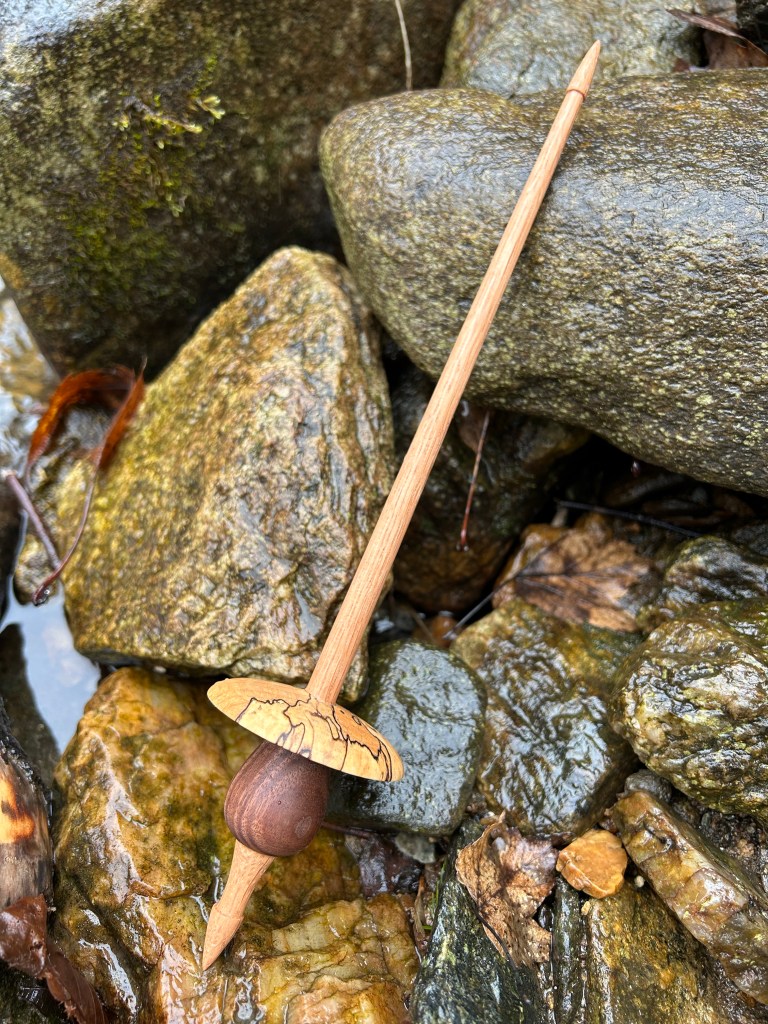
This spindle is made with an oak shaft, walnut body and spalted maple cap. I think they are stunning, and now I have a beautiful pair of spindles that perfectly represent me and Kyle. It is one of those things I didn’t even know I needed until I found them. I can’t wait to spin on these once my current project is done.
It’s funny, I was looking through some posts on my old blog the other day and came across one where I was talking about spinning. I had mentioned that while I loved spinning, I thought that maybe the drop spindle wasn’t for me and that as soon as I had a spinning wheel I knew I would just take off with it and never look back. And now here I am, waxing poetic about drop spindles until the cows come home. One of the big arguments for spinning wheels vs. drop spindles is efficiently. That spinning on a wheel is so much faster and therefore you can produce more yarn in a shorter amount of time. While that may be true for some, for me I think it is more a matter of which one I am more likely to pick up and work on. A drop spindle is easier to use if I have a spare 5 or 10 minutes and is more portable, whereas a wheel feels (is) more stationary. For example, I spun the 1.5 ounces above on my drop spindle in just a few weeks, versus the three ounces I now have on my wheel which has taken me OVER A YEAR to spin. (Granted, most of that year was spent not touching my spinning wheel, but that is exactly my point.) All things equal, it is possible that in 30 minutes of spinning on my wheel I might produce more yarn than 30 minutes of spinning on a drop spindle (that would be an interesting experiment), but it is the frequency of use for me that really makes a difference.
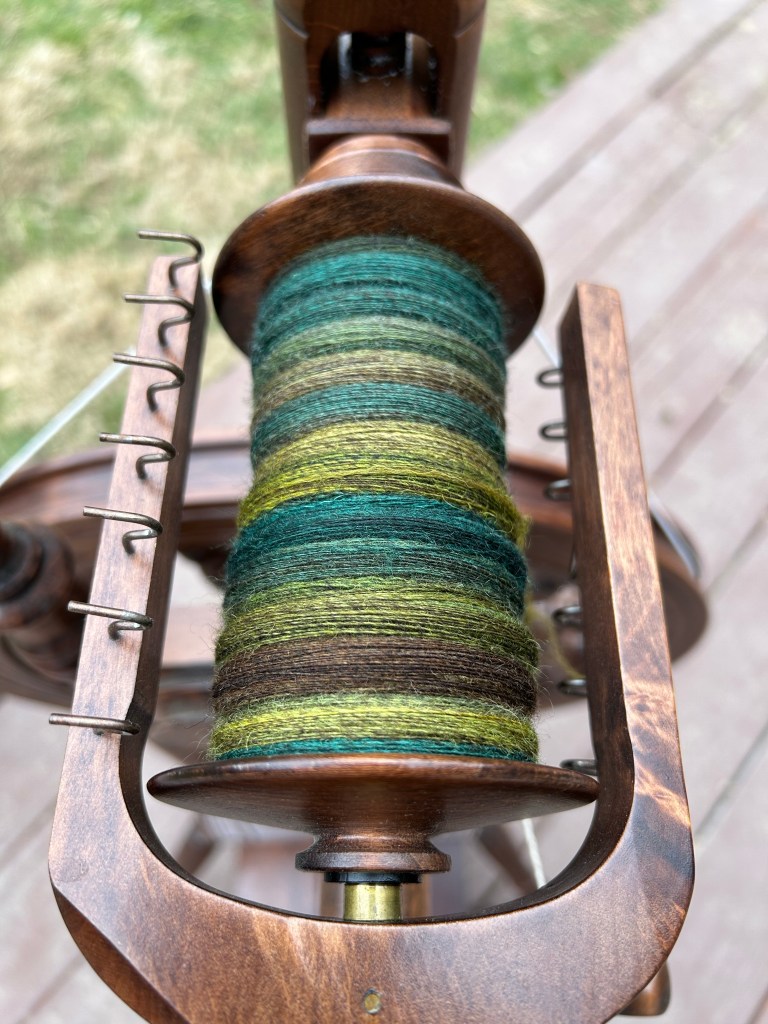
There is the additional variable here in that what I am spinning on my wheel is thinner than what is on the drop spindle, so it is taking longer to spin the same amount of wool, but I don’t think I am necessarily sold on the whole “spinning wheels are faster” idea. (Uh oh, here we go down another rabbit hole.) Drop spindles have been used for several thousand years and anybody who uses one regularly can become very proficient and productive. And many drop spindles are capable of adding twist to fiber faster than spinning wheels. My spinning wheel, a Kromski Minstrel, has a ratio of 1:16 using its smallest (fastest) whorl. That means that every time the drive wheel completes one revolution, the flyer (which adds twist to the fiber) rotates 16 times. If I treadle once every second, that equals 960 revolutions per minute. Drop spindles have been measured to spin at up to 10,000rpm. All of this to say, I think it truly comes down to personal preference, the type of spinning project you are working on (it is easier for me to spin long-draw on my wheel to produce a woolen-spun yarn), and how proficient you are at either style. I don’t consider myself proficient with either a spindle or a wheel, but am really enjoying exploring both and getting better with each project.
One of my goals for the year, in addition to spinning more, is to actually use my handspun yarn. I have a habit of spinning a skein of yarn and considering that project complete once the skein is washed and dried, but the yarn is of little value if it isn’t being used. Another goal of mine is to use the countless books on my bookshelf to make projects rather than just flipping through the pages and thinking “some day”. To that end, I recently shared a new book I received from my sister-in-law for Christmas, Nordic Knits with Birger Berge, and I plan to use my handspun to make this pair of mittens:
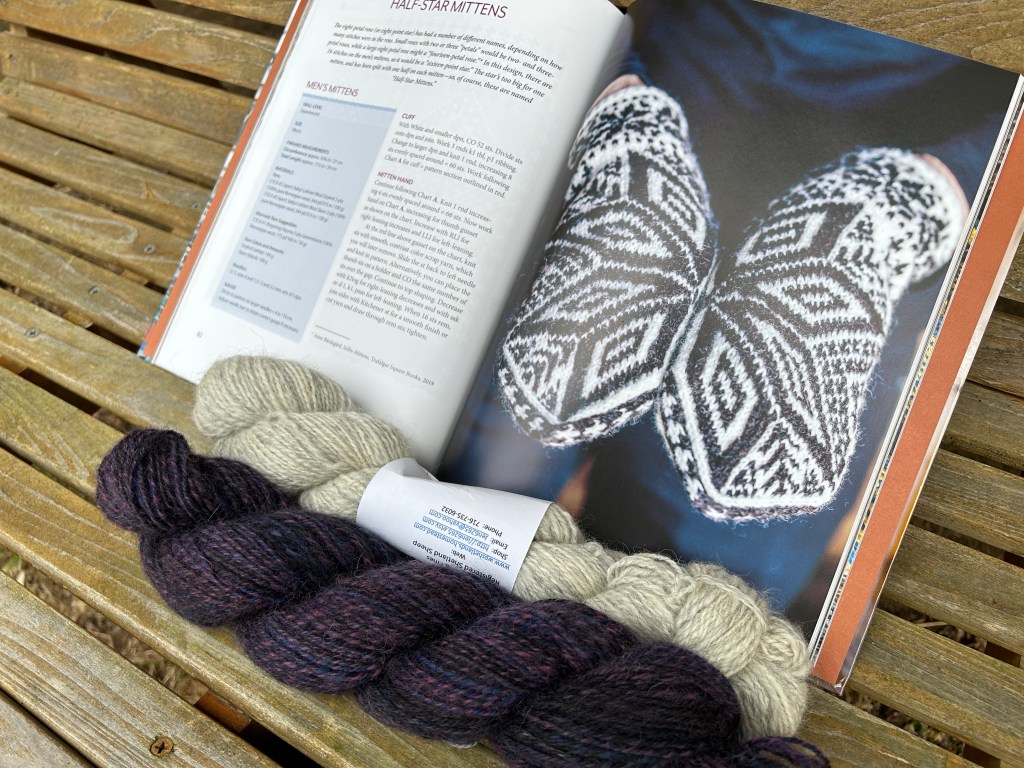
I think I am going to have to make some adjustments because my yarn is slightly thicker than what the pattern calls for, but I love a densely knit fabric (especially for mittens) and I am eager to see how these two skeins look when knit up. The gray is 2.9oz of Shetland wool I was given by the wonderful Joan (you know who you are) back in 2011, which I finally spun into a 2-ply yarn in 2020. The blue (blue?) is 4oz of Coopworth wool that I spun in 2013 to create a 3-ply yarn. The yarn was dyed by Dan Brewer from Gnomespun Yarn and Fiber Arts when he used to offer a fiber club. For that year, the theme was something about Mythical characters and I believe this was the “Morpheus” colorway. Dan put a lot of work into that club and each bump of fiber was accompanied by background information about the inspiration for the colorway and the fiber also came with a really beautiful stone stitch marker. It was my absolute favorite, but I haven’t seen it since 2016 when I moved out of my old apartment and I still mourn its loss. I would sign up for another of his fiber clubs in a heartbeat if he offered one again (hint hint, Dan!) I am glad to see that he is still in business and I love his new website (I don’t think it is new, but I have been out of the loop), and I didn’t realize he makes/sells spindles now, too!
I love that both of these handspun yarns have some variation in color which will bring more life and movement to the pattern on the mittens. I will have to do some gauge swatching to see how the colors play together and determine whether I need to make any adjustments to the pattern to account for my gauge and hand size.
And because I am all about meeting goals for this year (in an organic, no pressure sort of way), I am also preparing to cast on for my next pair of socks. This one will be for Kyle and, most notably, it will NOT be in ribbing or stockinette stitch, which are the only stitch patterns I have used for socks since (checks Ravelry projects) 2009. It is time to branch out again.

This gorgeous yarn is hand-dyed by Ryan of Ryan Yarn in Athens, Georgia and I ordered it from The Yarnery. This colorway is “Autumn Spice”, but his colors are so gorgeous that I also ordered “I’m So G(r)ay”, “Cloud Atlas”, “Design Your Universe”, and “Sea Castle”. It was just impossible to narrow it down any further than that.
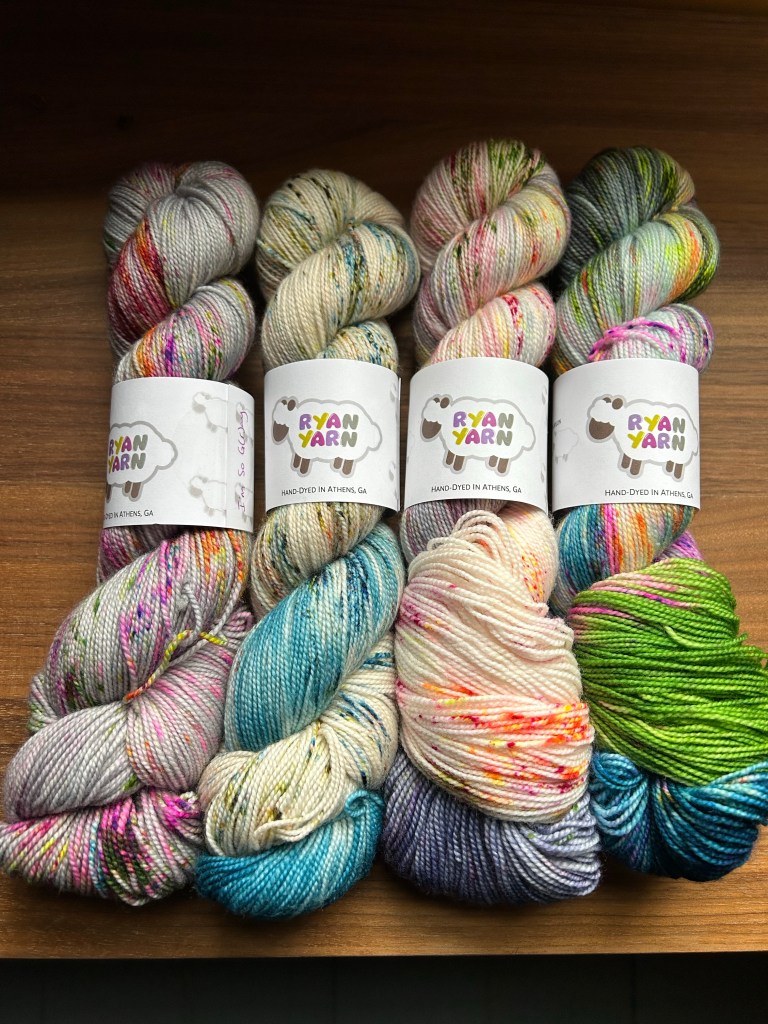
I have plenty of knitting in my future! Which is exactly as it should be.
*Ok, fine, I ordered four spindles, not two. But I will show you the other two later.
Until next time, stay creative.



 Spring Creek Textiles
Leave a comment